UCITS Versions: DMS Strategies for Investors Outside the US
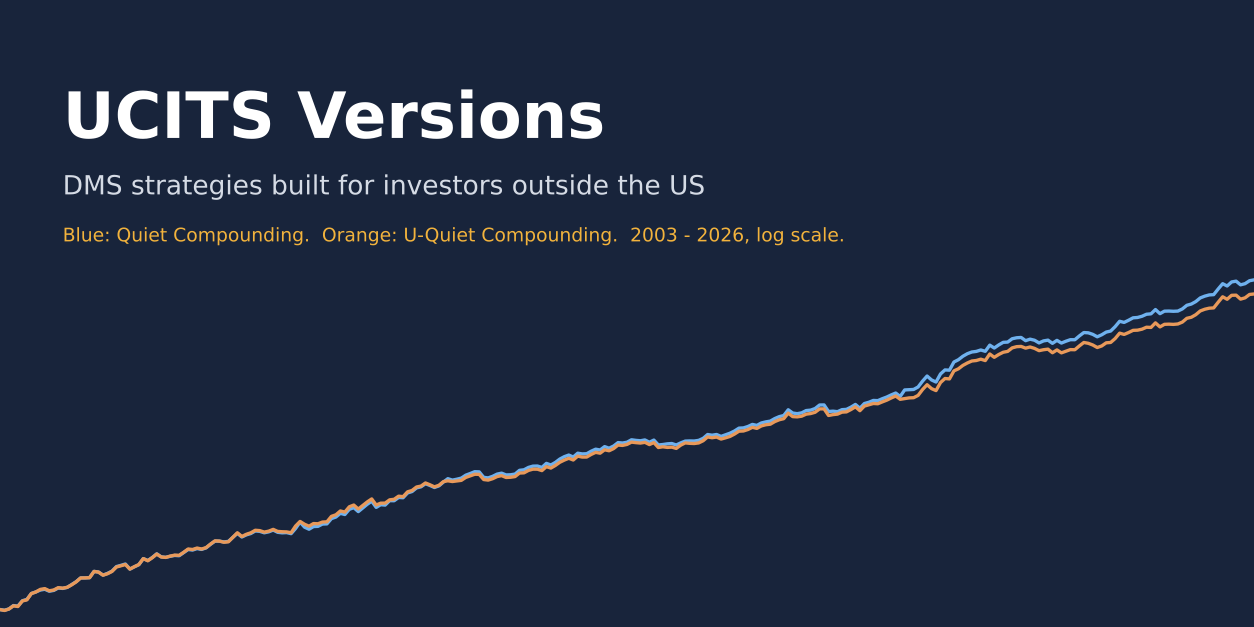
Every strategy on this site is built from US-listed ETFs. For an investor in the US that is ideal. For most investors anywhere else it's a wall. Recently an investor outside the US looked through the strategies, liked what he saw, and asked a simple question: could I provide versions he could actually invest in?
This post covers the answer. The short version: almost everything now has a UCITS version, every one of them holds only funds a non-US investor can buy, and the cost of the substitutions ranges from nothing to noticeable. I did the best I could with the funds that exist, and I'd rather show you exactly where that falls short than pretend it doesn't.
Why US-listed ETFs are a problem outside the US
In the UK and across the European Union, most retail brokers won't sell US-listed ETFs at all. European rules require a standardized key information document for funds sold to retail investors, and US fund companies generally don't produce one for their US funds. So an investor in London or Frankfurt who wants a strategy holding IWB, QQQ and TLT usually can't place the order.
Even where US ETFs can be bought, they're often a poor fit. A non-US investor holding US-domiciled funds can face a higher withholding tax on US dividends and, above a fairly low threshold, exposure to US estate tax.
The standard solution is UCITS funds: European-regulated funds, most of them domiciled in Ireland, that track the same indexes as their US counterparts and trade on the London Stock Exchange and European exchanges. iShares, Vanguard, SPDR, Xtrackers and others run UCITS versions of most of their major funds. Most, but not all, and that gap is the whole story of this project.
The one rule
I set one rule before building anything: every UCITS version must be fully buyable by a non-US investor. No "close enough" placeholders, no leaving a US fund in and hoping nobody notices.
There is exactly one exception, and it's a technical one. UCITS rules don't allow a fund that holds only gold, so there is no UCITS gold fund. Gold is held instead through the iShares Physical Gold ETC, a security backed by physical gold that is UCITS eligible and widely available to investors in the UK, Europe and elsewhere. It isn't a UCITS fund, but anyone who can buy the others can buy it.
How it works on the site
There's a new UCITS Investor switch next to Taxable Account. Turn it on and the strategy list switches to the UCITS versions, each marked with a "U-" in front: Carrier becomes U-Carrier, Triad becomes U-Triad, and so on. If you're looking at a strategy when you flip the switch, the site jumps to its UCITS version.
Holdings show the UCITS fund in place of the US ticker, with the US fund whose history it uses shown underneath. Hover over a fund to see its full name, ISIN and pound-sterling listing. Each strategy also has its own write-up listing every UCITS fund it can hold, with tickers and ISINs, and how closely each one matches.
Three things are worth knowing:
- The history is the US funds' history, in US dollars. Most UCITS funds are much younger than their US counterparts, so the long backtests are built on the US funds. The UCITS funds track the same or closely matching indexes, but their returns will differ a little, from fees and tax treatment if nothing else.
- Results are in US dollars. The tickers shown are the London USD listings. If you measure your portfolio in pounds, euros or anything else, your results will also move with the exchange rate.
- Taxable Account still works. Tax rates differ by country, but you can still enter your own rate to see the effect.
What changed in each DMS strategy
Where a UCITS fund tracks the same thing as the US fund, nothing changes but the ticker. The real work was in the handful of funds with no UCITS equivalent: the long/short equity fund (CLSE), the tail-risk fund (CAOS), the extended-duration Treasury fund (EDV), currency-hedged international stocks (DBEF), and US mid-cap value (IWS). Each one got the closest stand-in I could find, and I checked each choice against its neighbors to make sure I wasn't picking a lucky one.
| Strategy | What had to change |
|---|---|
| U-Carrier | No UCITS long/short equity fund. Its 15% goes to US large caps and managed futures, for a Risk On mix of 55% S&P 500, 20% Nasdaq 100 and 25% managed futures. |
| U-Catalyst | No UCITS tail-risk fund. Intermediate Treasuries take its place in the defensive blends. |
| U-Triad | No long/short equity fund, no mid-cap value fund and no extended-duration Treasuries. Mid caps stand in for mid-cap value, and long Treasuries for extended duration. International stocks are held without the currency-hedged partner. |
| U-Global Navigator | No currency-hedged international fund, so international stocks are held unhedged at full weight. Long Treasuries replace extended-duration Treasuries in the first month of Risk Off. |
| U-GPMv | Nothing. Every holding has a UCITS match. The one wrinkle is the Pacific position, which has no single UCITS fund and is held as a Japan fund and an Asia Pacific ex Japan fund, 55/45. |
| U-Quiet Compounding (and 125) | Built from the UCITS versions above, at the same weights and the same January reset. |
| U-Lowkey | U-Carrier for the 60%, and a new four-quadrant ballast for the 40% in place of Permanent Portfolio DMS (see below). |
The Smart Leverage versions carry over too. UCITS 2x funds exist for the S&P 500 and the Nasdaq 100, so there are UCITS versions of Carrier 170, Catalyst 200, Global Navigator 200, Triad 135 and Quiet Compounding 125. One practical note: the 2x Nasdaq 100 UCITS fund only trades in euros, in Paris, Milan and on Xetra.
What it costs
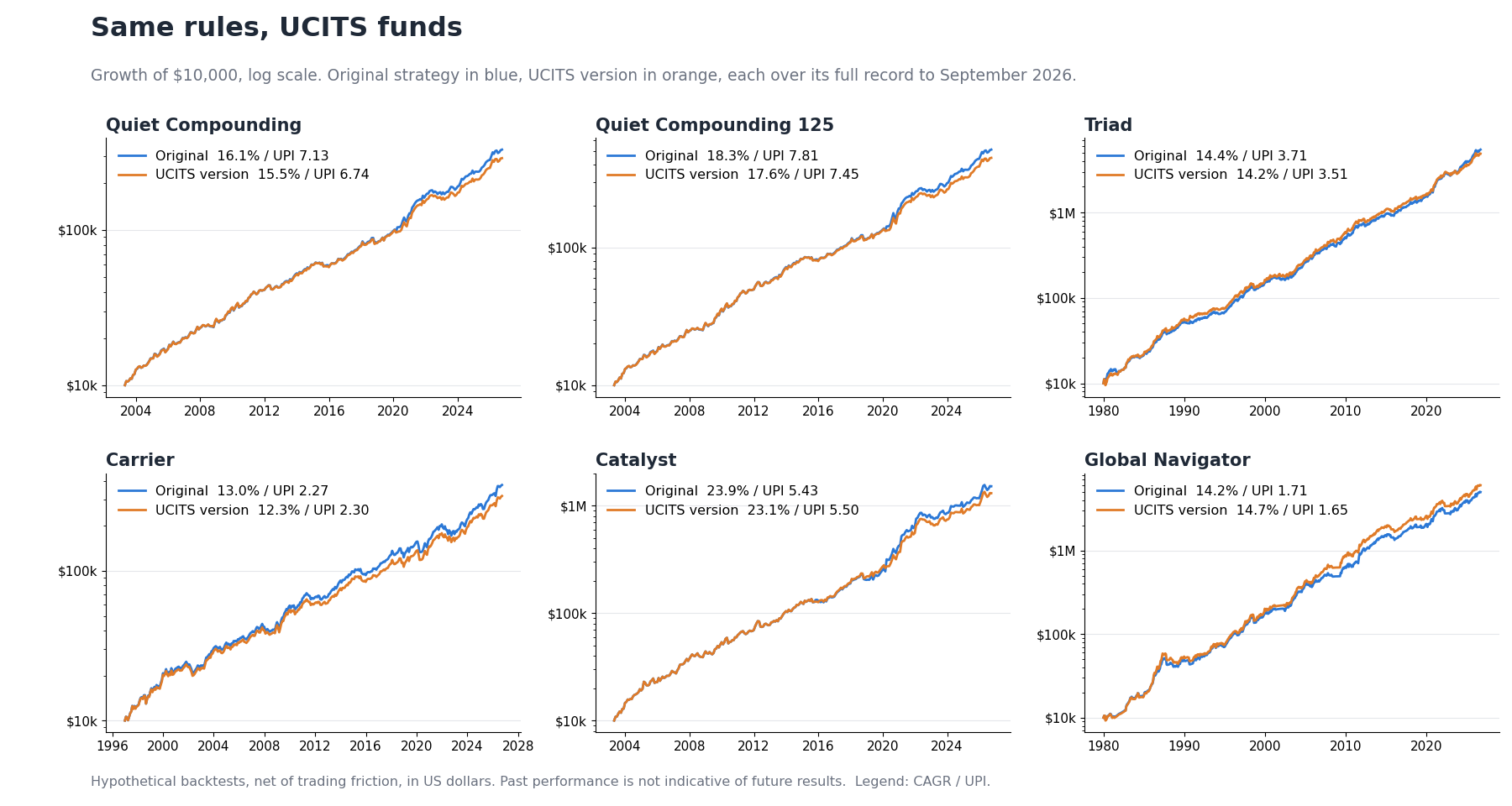
Here are the originals and their UCITS versions side by side:
And here's the full set, with the cost in return and in risk-adjusted return:
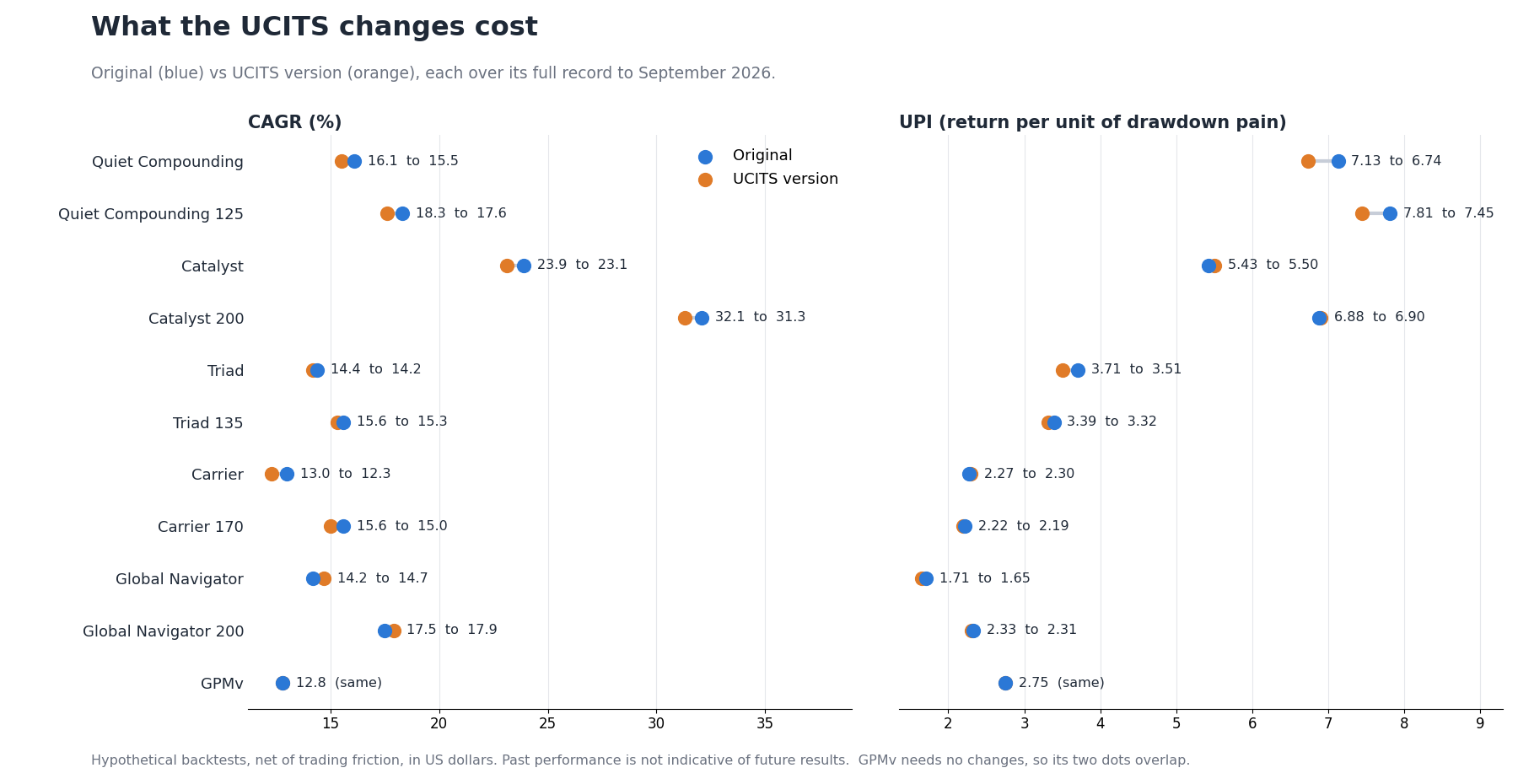
| Strategy | CAGR | Max Drawdown | UPI |
|---|---|---|---|
| Quiet Compounding | 16.1% | -6.8% | 7.13 |
| U-Quiet Compounding | 15.5% | -6.7% | 6.74 |
| Quiet Compounding 125 | 18.3% | -9.8% | 7.81 |
| U-Quiet Compounding 125 | 17.6% | -9.2% | 7.45 |
| Catalyst | 23.9% | -12.2% | 5.43 |
| U-Catalyst | 23.1% | -13.1% | 5.50 |
| Triad | 14.4% | -13.3% | 3.71 |
| U-Triad | 14.2% | -15.1% | 3.51 |
| Carrier | 13.0% | -16.2% | 2.27 |
| U-Carrier | 12.3% | -16.3% | 2.30 |
| Global Navigator | 14.2% | -22.0% | 1.71 |
| U-Global Navigator | 14.7% | -25.1% | 1.65 |
| GPMv | 12.8% | -11.7% | 2.75 |
| U-GPMv | 12.8% | -11.7% | 2.75 |
Net of trading friction, in US dollars, over each strategy's full record to September 2026: Quiet Compounding and Catalyst from May 2003, Carrier from January 1997, the others from January 1980.
A few honest observations:
- Quiet Compounding barely notices. Blending four strategies spreads the individual compromises thin. U-Quiet Compounding gives up about 0.6% a year with a slightly shallower drawdown, so the risk-adjusted result is close. If you're outside the US and want one portfolio, this is where I'd start.
- Triad gives up less return than you might expect, but more on risk. It loses three funds. U-Triad's return is only about 0.2% a year lower, but its worst drawdown is almost two points deeper and its UPI drops from 3.71 to 3.51. Nothing in the UCITS world behaves like the long/short fund in that sleeve.
- Carrier costs about three-quarters of a point a year for the same reason. The long/short fund was 15% of its Risk On mix.
- Catalyst trades return for smoothness. Intermediate Treasuries are a calmer hedge than a tail-risk fund, so U-Catalyst earns a little less but with a lower Ulcer Index and a better UPI.
- Global Navigator is a mixed result. Unhedged international stocks earned slightly more over the long run, but the worst drawdown is three points deeper. That's not a free lunch, just a different ride.
The third-party strategies
I also built UCITS versions of the outside models I track, so non-US investors can compare against them on the same footing: the eight Keller & Keuning strategies, Gary Antonacci's Global Equities Momentum and Composite Dual Momentum, and GTAA Agg3, the Permanent Portfolio, the Golden Butterfly and All Weather.
These turned out to be easy. Thirteen of the fourteen use only mainstream asset classes, every one of which has a UCITS fund, so their rules are untouched and their backtests are identical to the originals month for month.
The exception is GTAA Agg3, which ranks thirteen asset classes, one of them unhedged international government bonds. No UCITS fund holds that exposure, so U-GTAA Agg3 ranks the other twelve. The original held international bonds in only 37 of 561 months, so the change is small. It happened to help slightly over this history, but I wouldn't count on that going forward.
What isn't here yet
Not every strategy has a UCITS version. Permanent Portfolio DMS relies on a long/short fund and a tail-risk fund, neither of which has a UCITS equivalent, so swapping them out would leave a different strategy with the same name. I'd rather not publish that.
That also affects Lowkey, which holds Permanent Portfolio DMS for half of the portfolio. U-Lowkey keeps the original 60/40 shape, with U-Carrier for the 60% and a substitute ballast for the 40%. My first try was Harry Browne's original Permanent Portfolio in its place, but its long Treasuries took it down hard in 2022, when stocks and long bonds fell together, and U-Lowkey's worst decline went from -10% to -14%. So the 40% in U-Lowkey keeps Browne's four quadrants and changes two of the holdings: managed futures in place of long Treasuries, and the cash quadrant split between intermediate Treasuries and T-bills. That brings the worst decline back to about -9%, a little shallower than Lowkey's -10%. It still gives up about three-quarters of a point a year to Lowkey, which is the honest price of the funds that don't exist in UCITS form.
The 3x Smart Leverage variants are out too. UCITS funds stop at 2x leverage. The 3x products sold in Europe are exchange-traded notes, not UCITS funds, and I want every UCITS version to hold UCITS funds.
A word on what this isn't
This isn't tax or investment advice for your country. UCITS funds are the standard route for non-US investors, but tax rules, account types and what your broker offers vary a great deal from one country to the next. Check the specifics where you live.
If you're outside the US and give the UCITS versions a try, I'd like to hear how it goes, especially if a fund is hard to find at your broker or a better match exists that I've missed. These were built in response to a request, and the next round of improvements will probably come the same way.
Past performance, including backtested results, is not indicative of future results. Backtested performance is hypothetical, does not reflect actual trading, and benefits from hindsight in the selection of strategy rules. The UCITS versions are calculated on the history of the equivalent US-listed funds; the UCITS funds track the same or closely matching indexes, but their returns will differ, including from fees, tax treatment and currency.